

Science & Technology
Select a Level
NEW
4 Oct 2026
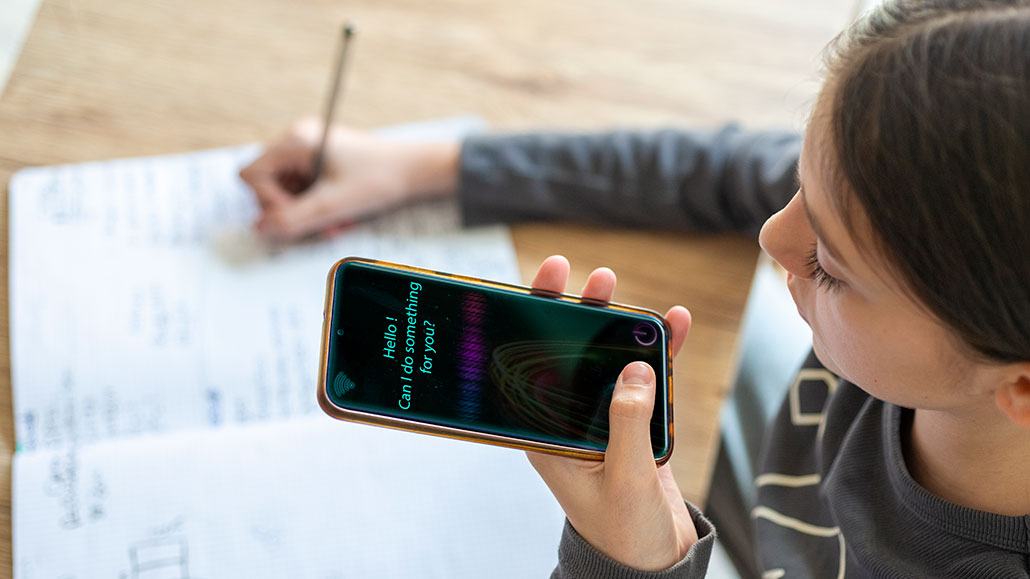
Some students are turning to AI for math help. That can be good or bad, a new survey finds. It depends on what they ask AI to do for them. Francesco Carta fotografo/Moment/Getty Images Plus
Can Artificial Intelligence (AI) Help You Learn Maths Better?
Warm-up → Read & Listen → Check Understanding → Language → Use It
WARM UP
Section: Warm Up
Think Ahead: Which detail do you think appears in this story?
a) AI helps students step by step with maths problems
b) Robots are replacing all teachers in schools today
c) Computers give students the answers immediately without working
Ask:
(1) Do you like using computers to practice school subjects?
(2) How do you feel when a maths problem is very hard?
VOCABULARY
tutor (/ˈtjuː.tər/, noun)
Meaning: A teacher who helps one student or a small group.
Example: My tutor helps me understand hard maths questions.
solve (/sɒlv/, verb)
Meaning: To find the correct answer to a problem.
Example: We work together to solve the puzzle.
hint (/hɪnt/, noun)
Meaning: A small clue that helps you guess or find an answer.
Example: The teacher gives a small hint to help us.
mistake (/mɪˈsteɪk/, noun)
Meaning: Something that is wrong or not correct.
Example: I fix my mistake with an eraser.
smart (/smɑːt/, adjective)
Meaning: Able to learn and understand things quickly.
Example: The smart computer helps children learn new words.
practice (/ˈpræk.tɪs/, verb)
Meaning: To do an activity many times to get better at it.
Example: Children practice reading every single day.
Many children practice maths every day at school. Sometimes maths is hard. Now, smart computer programs help students learn. A computer tutor works like a helpful guide. It does not just give the correct answer. Instead, it gives a small hint when a student is stuck.
Scientists test these new tools with young learners. The children try to solve tricky problems on screen. If a child makes a mistake, the program explains the step carefully. The tool shows how to think about the numbers. It speaks in a friendly voice. Children feel happy because they learn without stress. Teachers like these tools too. The computer helps each child at the right speed. Learning maths is becoming an exciting game for everyone.

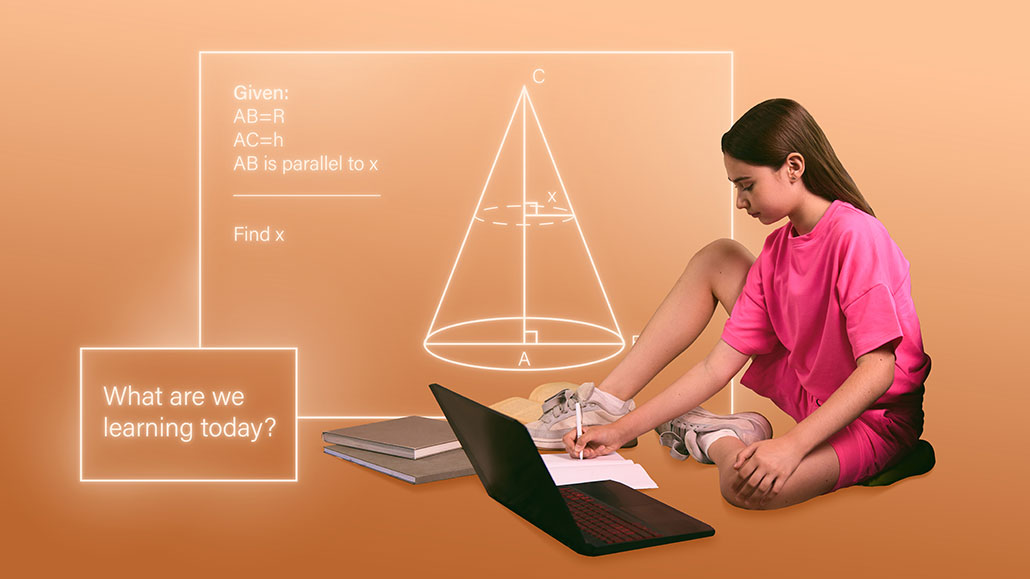
Using AI for help with homework or when studying for tests can be fine — as long as you keep thinking, doing the work and using a range of other resources, too. Anton Vierietin/iStock/Getty Images Plus
DISCUSSION QUESTIONS
1. Do you prefer learning maths from a computer or a human teacher?
2. What is your favourite subject at school?
3. How do you feel when you make a mistake in class?
4. Is it helpful when someone gives you a hint?
5. Do you think playing computer games can help you learn?
FILL IN THE GAPS
FILL THE GAPS
Section 1: Fill in the Gaps
Word Bank: practice, hint, solve, mistake
Many children _______(1) maths every day at school. Sometimes maths is hard. Now, smart computer programs help students learn. A computer tutor works like a helpful guide. It does not just give the correct answer. Instead, it gives a small _______(2) when a student is stuck.
Scientists test these new tools with young learners. The children try to _______(3) tricky problems on screen. If a child makes a _______(4), the program explains the step carefully. The tool shows how to think about the numbers. It speaks in a friendly voice. Children feel happy because they learn without stress. Teachers like these tools too. The computer helps each child at the right speed. Learning maths is becoming an exciting game for everyone.
Section 2: Main Idea
What is the main idea of the story?
a) Computers are taking away all school books from classrooms.
b) Smart computer tools give hints to help children learn maths.
c) Maths is too difficult for young children to understand.
UNDERSTANDING
Section 3: True or False
1. The computer tutor only gives the final answer immediately. T/F
2. The program explains steps carefully if a student makes a mistake. T/F
3. Teachers do not like using smart computer tools in schools. T/F
Section 4: Put Events in Order
Put these events in order from 1 to 3:
[ ] The student makes a mistake on a tricky problem.
[ ] The student tries to solve a problem on the screen.
[ ] The smart program gives a helpful hint to explain the step.
LANGUAGE
Section 5: Vocab Match
1. tutor
2. solve
3. hint
4. mistake
5. smart
a. something that is not correct
b. clever or able to learn quickly
c. a special teacher for one person
d. to find the right answer
e. a small clue to help someone
USE IT
Section 6: Discussion Builder
1. When I try a hard question, I want to _______ the answer myself.
a) solve
b) mistake
2. The friendly teacher gave me a small _______ to help me start.
a) tutor
b) hint
Section 7: Sentence Unscramble
1. Put these parts in order to make a sentence:
A) maths every day / B) Children / C) at school / D) practice / E) hard
2. Put these parts in order to make a sentence:
A) small hints / B) The smart program / C) to students / D) gives / E) on the screen
ANSWER KEY
Warm Up Answer: a
Section 1: 1. practice, 2. hint, 3. solve, 4. mistake
Section 2: b
Section 3: 1. False, 2. True, 3. False
Section 4: 2, 1, 3
Section 5: 1-c, 2-d, 3-e, 4-a, 5-b
Section 6: 1-a, 2-b
Section 7: 1) B - D - A - C (Children practice maths every day at school), 2) B - D - A - C - E (The smart program gives small hints to students on the screen)
Section 8: Open-ended student answers.

Thank you for your feedback!