

Science & Technology
Select a Level
NEW
30 Jul 2026
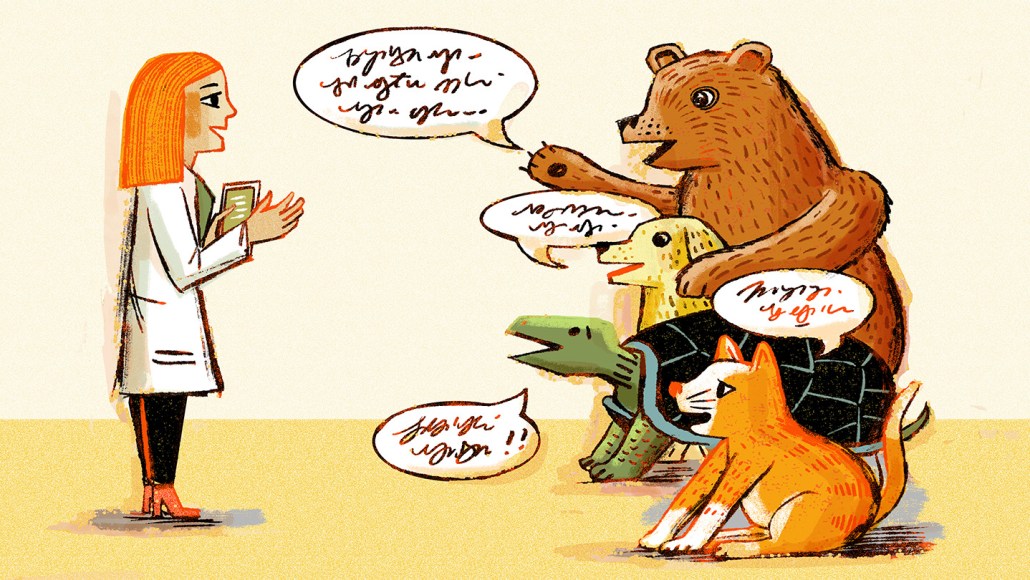
Imagine talking to — and understanding — other animals. Advances in decoding animal sounds might someday make that a possibility. ROBERT NEUBECKER
Cats and Dogs Could One Day ‘Speak’ in Our Language
Warm-up → Read & Listen → Check Understanding → Language → Use It
WARM UP
Warm Up Think Ahead: Which detail do you think appears in this story?
a) Scientists using technology to understand animal sounds.
b) Dogs learning to write words in English.
c) Whales living in a zoo in London.
Ask:
(1) What sounds does your pet or favourite animal make?
(2) Would you like to know what animals are saying?
VOCABULARY
communicate
(verb)
technology
(noun)
pattern
(noun)
translate
(verb)
excited
(adjective)
complicated
(adjective)
To share information or feelings with others.
Example: Dogs communicate by barking and wagging their tails.
Modern machines and equipment made using science.
Example: Scientists use new technology to study animal sounds.
A set of sounds or shapes that repeat.
Example: The computer found a pattern in the whale calls.
To change words from one language to another.
Example: An app might translate cat meows into English.
Feeling very happy and full of energy.
Example: The dog is excited to go to the park.
Difficult to understand or explain.
Example: Animal communication is very complicated.
Many people have pets at home like dogs and cats. We love our pets, but we do not always know what they want. When a dog barks or a cat meows, they are trying to communicate with us. Today, scientists are using special technology to learn more about animal sounds.
Artificial intelligence, or AI, can listen to thousands of animal noises. The computer program finds patterns in the sounds. For example, scientists used AI to study how whales make sounds in the sea. The AI showed that whale calls have different meanings. Other researchers are studying birds and farm animals.
In the future, we might have smart phone apps that translate pet sounds into human words. Imagine a collar that tells you when your dog is hungry or excited! However, scientists say that animal communication is still complicated. Dogs and cats do not use words with grammar like humans do. Even so, technology is helping humans understand our animal friends much better than before.

DISCUSSION QUESTIONS
1. What animal would you like to talk to first?
2. What do you think your pet says when it is hungry?
3. Do you think dogs or cats are easier to understand?
4. How would a pet translator help pet owners?
5. Why is animal communication interesting to scientists?
FILL IN THE GAPS
FILL THE GAPS
Section 1: Fill in the Gaps
Word Bank: communicate, pattern, technology, translate
Many people have pets at home like dogs and cats. We love our pets, but we do not always know what they want. When a dog barks or a cat meows, they are trying to _______(1) with us. Today, scientists are using special _______(2) to learn more about animal sounds.
Artificial intelligence, or AI, can listen to thousands of animal noises. The computer program finds _______(3) in the sounds. For example, scientists used AI to study how whales make sounds in the sea. The AI showed that whale calls have different meanings. Other researchers are studying birds and farm animals.
In the future, we might have smart phone apps that _______(4) pet sounds into human words. Imagine a collar that tells you when your dog is hungry or excited! However, scientists say that animal communication is still complicated. Dogs and cats do not use words with grammar like humans do. Even so, technology is helping humans understand our animal friends much better than before.
Section 2: Main Idea
What is the main idea of this article?
a) Technology is helping scientists understand how animals communicate.
b) Dogs and cats are learning to speak human languages.
c) Whales are the only animals that make sounds in the sea.
UNDERSTANDING
Section 3: True or False
1. Scientists are using artificial intelligence to listen to animal sounds. T/F
2. Whale calls all have the exact same meaning. T/F
3. Dogs and cats use complex grammar just like humans. T/F
Section 4: Put Events in Order
Put the following statements in the correct order from 1 to 3:
a) Scientists use AI to find patterns in animal noises.
b) People wonder what their pets are trying to say.
c) Smart phone apps may translate pet sounds in the future.
LANGUAGE
Section 5: Vocab Match
1. Communicate
2. Technology
3. Pattern
4. Translate
5. Complicated
a) Modern machines made using science
b) To share information with others
c) Something that is difficult to understand
d) A set of sounds that repeat
e) To change from one language to another
USE IT
Section 6: Discussion Builder
1. If I had a pet translator app, I would use it to _______ .
a) talk to my cat
b) sleep all day
c) build a house
2. Technology helps scientists _______ animal calls.
a) paint
b) understand
c) forget
Section 7: Sentence Unscramble
1. A) scientists B) animal C) study D) sounds E) modern
2. A) app B) translate C) pet D) can E) sounds
ANSWER KEY
Warm Up Answer: a
Section 1: Fill in the Gaps
communicate
technology
pattern
translate
Section 2: Main Ideaa
Section 3: True or False
True
False
False
Section 4: Put Events in Order
b
a
c
Section 5: Vocab Match1 - b 2 - a 3 - d 4 - e 5 - c
Section 6: Discussion Builder
a
b
Section 7: Sentence Unscramble
A - C - E - B - D (Scientists study modern animal sounds.)
C - A - D - B - E (Pet app can translate sounds.)
Section 8: Discussion Questions
Answers will vary. Student discussion.

Thank you for your feedback!