

Animals & Environment
Select a Level
NEW
30 Aug 2026
Wikimedia
Hermit Crabs Use Plastic Trash as New Shells
Warm-up → Read & Listen → Check Understanding → Language → Use It
WARM UP
Think Ahead: Which detail do you think appears in this story?
a) Hermit crabs wear plastic bottle caps on their backs.
b) Hermit crabs build houses out of sea sand.
c) Hermit crabs eat glass bottles on the beach.
Ask:
(1) Have you ever seen a hermit crab on a sandy beach?
(2) Why do small animals need hard homes to protect their bodies?
VOCABULARY
crab (/kræb/, noun)
Meaning: A small sea animal with ten legs and two claws.
Example: A little red crab walks on the sand.
shell (/ʃel/, noun)
Meaning: A hard cover that protects a sea animal.
Example: The hermit crab hides inside its hard shell.
plastic (/ˈplæs.tɪk/, noun)
Meaning: A light material used to make bottles and toys.
Example: We do not throw plastic into the ocean.
beach (/biːtʃ/, noun)
Meaning: An area of sand next to the sea.
Example: Children play and run on the beach.
cap (/kæp/, noun)
Meaning: A small round cover for a bottle.
Example: The red bottle cap is on the sand.
clean (/kliːn/, verb)
Meaning: To remove dirt or rubbish from a place.
Example: We clean the beach to help small animals.
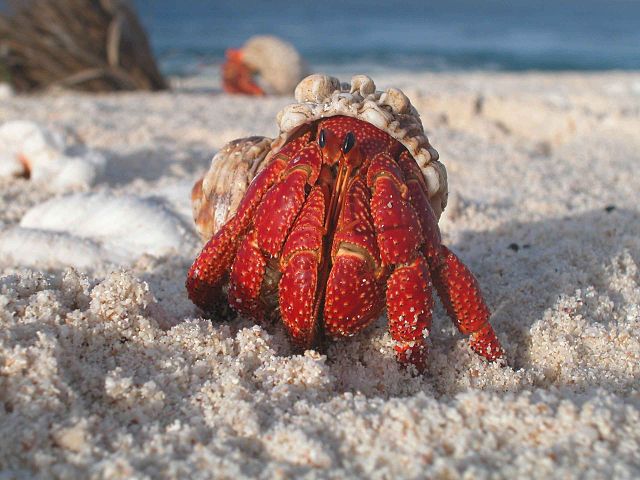
Hermit crabs live on warm beaches near the blue sea. These small crabs do not grow hard shells. They need empty sea shells to protect their soft bodies. The crabs walk on the sand and look for new homes.
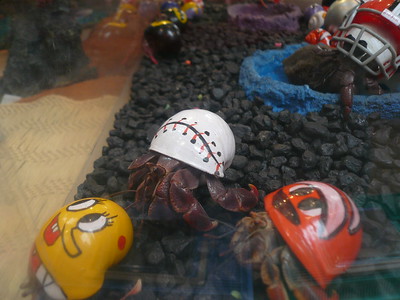
Today, many beaches have plastic rubbish. Scientists see hermit crabs with colourful plastic bottle caps on their backs. The crabs choose these plastic caps because real sea shells are hard to find. The caps are light and cover their bodies well.
However, plastic is not always safe for tiny sea animals. Some crabs get trapped inside deep bottles and cannot get out. Children can help the crabs today. We must pick up plastic rubbish and keep our beaches clean.
Now, people around the world are working together. Children pick up rubbish on the sand every weekend. The ocean becomes safer for hermit crabs and fish. Beautiful sea shells stay on the beach for small crabs to find.

Flickr
DISCUSSION QUESTIONS
1. Have you ever seen a hermit crab on a beach?
2. Why do hermit crabs need hard shells?
3. What colours of bottle caps do you see in recycling bins?
4. How can we keep beaches clean for sea animals?
5. Why is it important to pick up rubbish?
FILL IN THE GAPS
FILL THE GAPS
Section 1: Fill in the Gaps
Word Bank: cap, crab, plastic, shell
Hermit crabs live on warm beaches near the blue sea. These small crabs do not grow hard shells. They need empty sea _______(1)s to protect their soft bodies. The crabs walk on the sand and look for new homes.
Today, many beaches have _______(2) rubbish. Scientists see hermit crabs with colourful plastic bottle caps on their backs. The crabs choose these plastic caps because real sea shells are hard to find. The _______(3)s are light and cover their bodies well.
However, plastic is not always safe for tiny sea animals. Some crabs get trapped inside deep bottles and cannot get out. Children can help the _______(4)s today. We must pick up plastic rubbish and keep our beaches clean.
Now, people around the world are working together. Children pick up rubbish on the sand every weekend. The ocean becomes safer for hermit crabs and fish. Beautiful sea shells stay on the beach for small crabs to find.
Section 2: Main Idea
Choose the main idea of the story:
a) Hermit crabs use plastic bottle caps as homes because real shells are hard to find on beaches.
b) Hermit crabs like to eat colourful plastic bottles on the beach.
c) Scientists build big plastic houses for crabs in the sea.
UNDERSTANDING
Section 3: True or False
1. Hermit crabs grow their own hard shells. T/F
2. Many hermit crabs wear plastic bottle caps on their backs. T/F
3. Plastic bottles are always safe for small sea animals. T/F
Section 4: Put Events in Order
Put the events in order (1-3):
( ) Scientists see crabs wearing plastic bottle caps on beaches.
( ) People work together to clean plastic rubbish from the sand.
( ) Hermit crabs search for empty shells to protect their soft bodies.
LANGUAGE
Section 5: Vocab Match
1. crab
2. shell
3. plastic
4. beach
5. cap
a. A small round cover for a bottle.
b. A light material used to make bottles and toys.
c. A sea animal with ten legs and two claws.
d. An area of sand next to the ocean.
e. A hard outer cover that protects an animal.
USE IT
Section 6: Discussion Builder
1. Hermit crabs walk along the beach to _______ new homes.
a) search for
b) fly over
c) paint blue
2. We should clean the sand so sea animals stay _______.
a) safe and happy
b) cold and angry
c) noisy and tall
Section 7: Sentence Unscramble
1. [A] Hermit crabs [B] live on [C] warm beaches [D] near the [E] blue sea.
2. [A] Children pick up [B] plastic rubbish [C] to keep [D] the ocean [E] clean.
ANSWER KEY
A1 Level Answer Key
Warm Up: a
Section 1: (1) shell, (2) plastic, (3) cap, (4) crab
Section 2: a
Section 3: 1. False, 2. True, 3. False
Section 4: Order: 2, 3, 1
Section 5: 1-c, 2-e, 3-b, 4-d, 5-a
Section 6: 1-a, 2-a
Section 7: 1. Hermit crabs live on warm beaches near the blue sea. 2. Children pick up plastic rubbish to keep the ocean clean.
Section 8: Open-ended student answers.

Thank you for your feedback!