

Science & Technology
Select a Level
NEW
18 Aug 2026
Matt Chinworth
Why Math is Harder for Some Kids - How Brains Process Numbers
Warm-up → Read & Listen → Check Understanding → Language → Use It
WARM UP
Think Ahead: Which detail do you think appears in this story?
a) Children learn maths best when they stay up very late.
b) Scientists scanned children's brains while they did a maths test.
c) Computer screens can make numbers turn into small animals.
Ask:
(1) Do you find maths easy or hard at school?
(2) What tools help you count numbers in class?
VOCABULARY
brain
(noun) /breɪn/
count
(verb) /kaʊnt/
dot
(noun) /dɒt/
mistake
(noun) /mɪˈsteɪk/
slow
(adjective) /sləʊ/
symbol
(noun) /ˈsɪm.bəl/
test
(noun) /test/
The part inside your head that helps you think.
Example: Your brain helps you solve maths problems.
To find the total number of things.
Example: Children count dots on the screen.
A small round mark on a page or screen.
Example: The teacher drew a red dot on the board.
An action or answer that is not correct.
Example: I made a small mistake in my test.
Moving or doing something with little speed.
Example: Please be slow and careful with your work.
A shape or sign used to show a number.
Example: The number 5 is a mathematical symbol.
A set of questions to check what you know.
Example: We had a short maths test today.
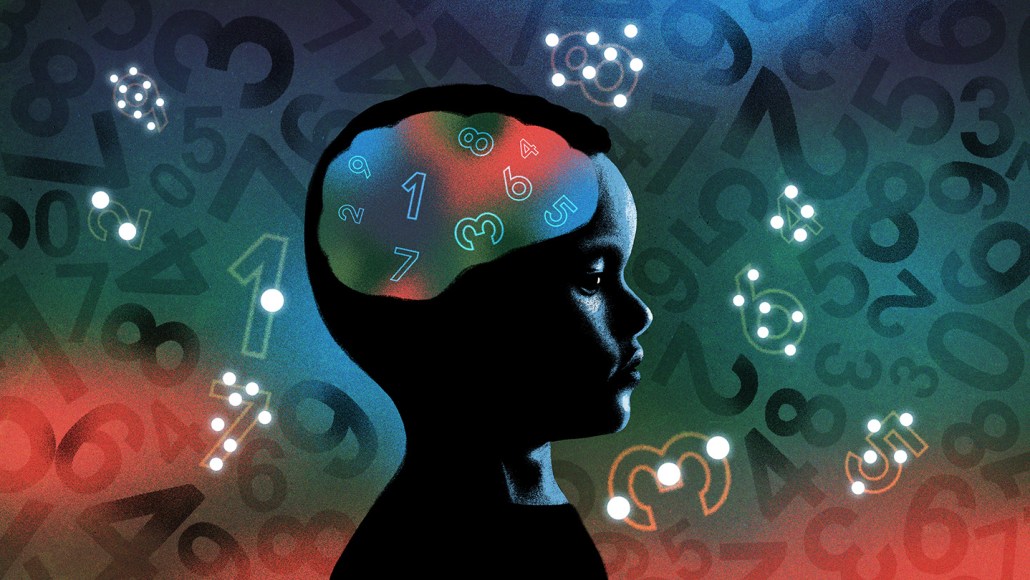
Maths can be hard for many children. Scientists wanted to find out why. They studied young pupils in school. They looked at how children learn numbers.
In the study, children did a special test. They looked at numbers on a screen. They picked the larger number. Scientists scanned their brains during the test.
Some children made mistakes when they saw number symbols like 5 or 9. They moved too fast. They did not slow down after making an error. Their brains showed less activity in parts that check work.
Then, scientists changed the test. They used groups of dots instead of written numbers. Something amazing happened. All the children did well with the dots. Children who struggled before became calm and careful. They slowed down after mistakes.
This study shows that dots can help children learn. Written numbers are hard symbols for young brains. Using dots or pictures helps pupils understand maths much better.


Phynart Studio/E+/Getty Images
DISCUSSION QUESTIONS
1. Do you find maths easy or difficult at school?
2. How do you feel when you make a mistake in class?
3. Do you prefer counting written numbers or counting dots?
4. What games do you play that use numbers?
5. How can teachers help pupils feel happy during maths lessons?
FILL IN THE GAPS
FILL THE GAPS
Section 1: Fill in the Gaps
Word Bank: slow, dots, mistakes, symbols
Maths can be hard for many children. Scientists wanted to find out why. They studied young pupils in school. They looked at how children learn numbers.
In the study, children did a special test. They looked at numbers on a screen. They picked the larger number. Scientists scanned their brains during the test.
Some children made _______(1) when they saw number _______(2) like 5 or 9. They moved too fast. They did not _______(3) down after making an error. Their brains showed less activity in parts that check work.
Then, scientists changed the test. They used groups of _______(4) instead of written numbers. Something amazing happened. All the children did well with the dots. Children who struggled before became calm and careful. They slowed down after mistakes.
This study shows that dots can help children learn. Written numbers are hard symbols for young brains. Using dots or pictures helps pupils understand maths much better.
Section 2: Main Idea
Which sentence gives the best main idea of the story?
a) Scanning brains shows why maths with dots is impossible.
b) Using dots instead of number symbols helps children learn maths.
c) Children do not like doing tests on computer screens.
UNDERSTANDING
Section 3: True and False
1. Scientists scanned children's brains during a maths test. T/F
2. All children found number symbols very easy to understand. T/F
3. Children worked more carefully when they looked at dots. T/F
Section 4: Put Events in Order
Put these events in order from 1 to 3:
a) Children looked at pictures of dots instead of written numbers.
b) Scientists scanned children's brains while they picked larger numbers.
c) Researchers noticed that dots helped children slow down and fix mistakes.
LANGUAGE
Section 5: Vocab Match
1. Brain
2. Symbol
3. Mistake
4. Dot
5. Test
a) A small round mark on a page or screen
b) An action or answer that is not correct
c) A shape or sign used to show an idea or number
d) The part inside your head that helps you think
e) A set of questions to check what someone knows
USE IT
Section 6: Discussion Builder
1. When I do maths problems, I like to take my time so I do not make a _______.
a) dot
b) mistake
c) brain
d) picture
2. My teacher uses small red _______ on paper to help us count items.
a) dots
b) tests
c) brains
d) screens
Section 7: Sentence Unscramble
Unscramble the words to make complete sentences:
1. A) scanned / B) brains / C) the / D) children's / E) Scientists.
2. A) numbers / B) help / C) Dots / D) understand / E) pupils.
ANSWER KEY
Warm Up Answer:
Correct detail: b) Scientists scanned children's brains while they did a maths test.
Section 1: Fill in the Gaps
mistakes
symbols
slow
dots
Section 2: Main Idea
b) Using dots instead of number symbols helps children learn maths.
Section 3: True and False
True
False
True
Section 4: Put Events in Order
b (Scientists scanned children's brains while they picked larger numbers.)
a (Children looked at pictures of dots instead of written numbers.)
c (Researchers noticed that dots helped children slow down and fix mistakes.)
Section 5: Vocab Match
1-d, 2-c, 3-b, 4-a, 5-e
Section 6: Discussion Builder
b) mistake
a) dots
Section 7: Sentence Unscramble
E-A-C-D-A (Scientists scanned the children's brains.)
C-B-E-D-A (Dots help pupils understand numbers.)
Section 8: Discussion Questions
Student discussion activity - responses will vary.

Thank you for your feedback!